Search engine optimization for an insurance agency should have one primary objective: help the right people find your agency when they are actively looking for the products, expertise, or guidance you provide.
That sounds simple, but insurance SEO gets complicated quickly. Independent agencies compete against national carriers, lead aggregators, large publishers, directories, other local agencies, and increasingly, AI-generated answers and recommendations.
The good news is that you do not need to outrank every insurance company on the Internet to build a profitable organic search strategy.
In fact, I think that’s where many insurance agencies get SEO completely wrong.
We’ve worked on insurance websites and lead generation strategies across Medicare, life insurance, annuities, final expense, health insurance, and other insurance markets. One lesson has remained consistent: the goal isn’t traffic for the sake of traffic. The goal is to create search visibility that can eventually turn into conversations, opportunities, policies, and revenue.
This guide explains how we approach SEO for insurance agencies at Redbird and how independent agents can build an organic search strategy that actually supports their business.
Want Redbird To Handle SEO For You?
Don’t want to do all of this yourself? Let our team help you!
What Is SEO for an Insurance Agency?
Insurance agency SEO is the process of improving your website and overall digital presence so that search engines can better understand who you are, what insurance products you specialize in, where you do business, and which searches your website can help answer.
At the most basic level, SEO helps connect three things.
- What your potential customer is searching for.
- The information and expertise your agency can provide.
- The pages on your website that best answer that search.
Search engines use automated bots to discover and crawl web pages, follow links, interpret HTML, and add eligible pages to their indexes. A sitemap can help search engines discover important URLs, but discovery is only the beginning. Search algorithms still have to determine which pages are relevant and useful for a particular search query.
For an insurance agency, that can include searches for products, insurance companies, underwriting questions, costs, comparisons, local agents, Medicare plans, life insurance options, annuities, coverage questions, and thousands of highly specific situations consumers encounter before buying insurance.
The opportunity is much larger than trying to rank for a handful of obvious phrases like “life insurance” or “Medicare.”
That’s important because those broad terms are also where independent agencies are most likely to compete against companies with enormous marketing budgets.
Why Insurance SEO Is Different
Insurance isn’t a simple ecommerce transaction.
A consumer searching for shoes might know exactly what they want. Insurance searches are often triggered by a life event, financial problem, health condition, enrollment period, confusing product decision, or question the consumer doesn’t know how to answer.
That creates an enormous number of potential searches.
Consider life insurance. Someone might search:
- How much life insurance do I need?
- Term vs whole life insurance.
- Life insurance for diabetics.
- Life insurance with high cholesterol.
- Best life insurance for a business owner.
- Life insurance agent near me.
- Independent life insurance agent in St. Louis.
Those searches all relate to life insurance, but they represent very different people at very different stages of the buying process.
The Redbird Insurance SEO Framework
We think about insurance SEO as a business system rather than a collection of SEO tricks.
Market
Start with the business you actually want to write. Which products do you sell? Which customers are profitable? Which geographic markets do you serve? Where do you have carrier relationships, underwriting expertise, local knowledge, or another competitive advantage?
Intent
Determine how those customers search before, during, and immediately before a buying decision. Some searches are educational. Others show comparison intent. Some are clearly local. Others indicate that a consumer may already be looking for an agent.
Content
Create the best useful resource you can for those searches. That may be a product page, city page, comparison, calculator, guide, FAQ, case study, directory, article, video, or some combination of those formats.
Authority
A page doesn’t exist in isolation. Your website needs supporting content, internal links, external references, reviews, citations, backlinks, author information, and other signals that help users and search engines understand why your website deserves attention.
Conversion
Traffic without a logical next step isn’t much of a marketing strategy. Depending on the search, the appropriate action might be requesting a quote, scheduling a conversation, finding an agent, using a calculator, downloading a resource, or continuing to another useful page.
Measurement
Rankings and traffic are useful indicators, but an insurance agency ultimately needs to understand whether organic search contributes to leads, opportunities, policies, premium, and revenue.
Where Insurance Agencies Should Focus Their SEO Efforts
There are dozens of things you could work on. These are the areas I would prioritize first.
Search Intent
Identify what prospective customers are actually trying to accomplish when they search.
Site Architecture
Organize products, markets, and supporting content into a logical website structure.
Content Strategy
Turn actual insurance questions, problems, and expertise into useful search resources.
Internal Linking
Connect related resources and establish which pages matter most within your website.
Local SEO
Improve visibility for consumers looking for insurance expertise in markets you serve.
Measurement
Connect organic visibility to leads, opportunities, policies, premium, and revenue.
1. Start With Search Intent, Not Search Volume
This is one of the most important lessons we’ve learned from working with insurance websites.
A keyword with 20 searches per month can be more valuable to an independent insurance agency than a keyword with 20,000 searches per month.
Why?
Intent.
The lesson: Search volume tells you how often something may be searched. It doesn’t tell you how valuable that search is to your insurance agency.
The first phrase may generate dramatically more searches, but that doesn’t automatically make it the better opportunity for an independent agency.
We’ve written extensively about the value of long-tail insurance keywords because specific searches can reveal exactly what problem a consumer is trying to solve.
An agent who understands impaired-risk life insurance, for example, may have hundreds or thousands of potential content opportunities based on health conditions, medications, ages, occupations, hobbies, and underwriting situations.
2. Build Your Website Around Products, Problems, and Markets
One of the most common problems we see with insurance websites is poor organization.
An agency may sell five different products, serve several states, publish dozens of articles, and still give search engines and visitors very little indication of which pages are most important.
Your website architecture should reflect your business.
Example: Medicare Website Architecture
Medicare
│
├── Medicare Advantage
│   ├── Missouri
│   │   ├── St. Louis
│   │   ├── Kansas City
│   │   └── Springfield
│   │
│   └── Other Markets
│
├── Medicare Supplement
│
├── Medicare Part D
│
└── Medicare Resources
    ├── Enrollment
    ├── Eligibility
    ├── Costs
    └── Agent Resources
The exact structure will depend on the agency. The point is that related information should actually be related within the architecture of the website.
3. Create Content That Supports Your Business
Insurance agencies have an almost unlimited supply of potential content because agents answer questions every day.
Those questions are often your keyword research.
Think About Your Last 10 Clients
- What did they ask?
- What confused them?
- What made their situation unusual?
- What did they compare?
- What almost prevented them from buying?
- What did you explain that finally made the decision clear?
Those conversations can become valuable search content.
This is also why I don’t believe insurance content should simply be outsourced to someone who understands SEO but doesn’t understand insurance.
The writer can help organize and optimize the information. The subject matter expertise still needs to come from people who understand the product and the customer.
We’ve used this philosophy for years when building insurance blog content: go deep instead of wide, define the audience, solve an actual problem, and give the reader a logical next step.
Use Content Briefs Before You Start Writing
A useful content brief should identify:
- The objective of the page.
- The target audience.
- The primary question or problem.
- The search intent.
- The primary and supporting topics.
- Internal links that should be included.
- First-hand experience or examples that should be added.
- The desired call to action.
Our guide on creating an SEO content brief for an insurance agency goes deeper into this process.
4. Build an Internal Linking Structure
This is one of the most overlooked opportunities on established insurance websites.
Publishing more content isn’t always the answer.
If you already have 100, 200, or 500 pages, the bigger opportunity may be organizing what you already have.
Internal links help users discover related information and establish relationships between pages.
Think Hub and Spoke
                         Supporting Article
                                │
                                ↓
Local Market Page ────→ CORE PRODUCT PAGE ←──── Comparison Article
                                ↑
                                │
                         Supporting Guide
If your primary Medicare Advantage page is important, your related articles about enrollment periods, plan types, costs, eligibility, local markets, and common questions should naturally reference it when appropriate.
The core page should also help users discover those deeper resources.
Use Descriptive Anchor Text
The words you link should help the reader understand what comes next.
Weak: Learn more about long-tail keywords here.
Better: Learn how long-tail keywords can generate insurance leads.
Don’t force the same keyword-rich anchor into every page. Write for the reader and make the destination clear.
5. Own Your Local Insurance Market
Local SEO is one of the areas where an independent insurance agency can have a legitimate competitive opportunity.
You may not have the resources to outrank national insurance brands for every broad product term. You may have a much better opportunity when a consumer wants an actual professional in a specific market.
Google describes the primary factors behind local results as relevance, distance, and prominence.
Relevance
Does your digital presence clearly explain what your agency does and the insurance products and services you provide?
Distance
Local search is actually local. Geography matters, which is why agencies should focus on markets they legitimately serve.
Prominence
Reviews, links, mentions, directories, articles, and the broader visibility of the business can help establish prominence.
Optimize Your Google Business Profile
Google Business Profile, formerly known as Google My Business, is one of the most important assets to maintain for an eligible local insurance agency.
Keep your Google Business Profile accurate and complete. Pay attention to your business information, categories, hours, services, photos, reviews, and other relevant information available for your profile.
Keep Your Business Information Consistent
Your agency name, address, phone number, website, and other core business information should be accurate wherever consumers and search engines encounter your business. Depending on your agency and market, that can include Google Business Profile, Yelp, relevant insurance directories, professional profiles, and other legitimate citations.
6. Optimize the Important Pages on Your Insurance Website
On-page SEO doesn’t need to become a science project. For every page that matters to your business, make sure the fundamentals are handled well.
Page Title
Clearly describe what the page is about and give someone a reason to choose it from the search results.
Headings
Use one clear primary heading and logical subheadings to break complicated insurance subjects into understandable sections.
Introduction
Don’t spend 500 words warming up. Tell the reader what they’re going to learn and start answering the question.
URL
Use a readable URL that reflects the topic. Avoid unnecessary complexity when a simple descriptive URL will work.
Internal Links
Connect the page to relevant supporting resources, parent pages, and logical next steps. Important pages shouldn’t exist as islands within your website.
Images and Supporting Media
Use images, screenshots, charts, calculators, videos, and other supporting media when they genuinely help explain the subject. Give meaningful images descriptive alternative text.
Call to Action
Determine what someone should logically do after consuming the page. Not every visitor is ready to request a quote. Sometimes the right next step is another article, a calculator, a comparison, an agent search, or a conversation.
7. Update Existing Insurance Content
One of the biggest SEO opportunities on an established insurance website may already exist in your content library.
Insurance changes. Products change. Regulations change. Carrier availability changes. Commissions change. Statistics become outdated. Links break. Search behavior changes.
Before Creating Another Article, Ask:
- Is the existing information still accurate?
- Can I add current first-hand experience?
- Are there outdated statistics?
- Are the internal links still appropriate?
- Does the article answer the searcher’s question quickly enough?
- Are there sections that no longer add value?
- Have we published newer content that should be connected to this page?
- Is the call to action still relevant?
8. Build Authority Beyond Your Own Website
You can tell everyone you’re the greatest insurance agent in America.
That’s still you saying it about yourself.
External validation is different.
Backlinks remain useful, but insurance agencies should think more broadly about link building. The goal isn’t to accumulate as many backlinks as possible. It’s to earn legitimate references from websites and organizations that make sense for your business, expertise, industry, or local market.
Potential sources of authority can include:
- Industry publications.
- Professional associations.
- Local organizations.
- Insurance directories.
- Podcasts and interviews.
- Original research and data.
- Community involvement.
- Useful tools and calculators.
- Expert contributions.
- Carrier and industry relationships when appropriate.
9. Reviews and Reputation Are Part of Search
Reviews shouldn’t be treated as something separate from your digital marketing strategy.
For a local insurance agency, they help potential clients evaluate whether they want to trust you before they ever call.
They also contribute to your broader digital footprint.
Build a repeatable process for requesting legitimate reviews from clients and make sure you monitor and respond appropriately.
We’ve put together a complete insurance agent’s guide to getting more online reviews that goes deeper into this strategy.
10. Insurance SEO Now Extends Beyond Traditional Search
Consumers no longer discover insurance information through a single search box.
Traditional search engines such as Google Search and Bing still matter tremendously, but online visibility now extends beyond a traditional list of search results. Consumers can also use AI assistants and other answer-driven tools to research products, compare options, understand terminology, and identify professionals.
This doesn’t mean abandoning traditional SEO.
It means the work you should already be doing becomes even more important:
- Publish useful original information.
- Clearly identify authors and subject matter experts.
- Keep business information accurate.
- Build legitimate third-party references.
- Earn customer reviews.
- Create consistent information about your agency across the web.
- Support claims with evidence.
- Update outdated content.
- Make complicated insurance subjects easy to understand.
Our article on how AI systems may find and evaluate insurance agents explores this shift in much greater detail.
11. Measure Insurance SEO Like a Business Owner
This is where I think insurance agencies need to get much more disciplined.
Rankings matter. Traffic matters. Impressions matter.
But none of those numbers pays an agent.
The SEO Revenue Funnel
Search Impressions → Organic Visitors → Leads → Qualified Opportunities → Policies → Premium → Revenue
If your SEO company reports that organic traffic increased 80%, your next question should be:
What happened to the business?
Suppose an agency generates 5,000 additional organic visitors but almost none of them become qualified opportunities.
That’s interesting traffic. It may even have strategic value. But it isn’t automatically successful lead generation.
Now compare that with a highly specific page that generates only 100 visitors but produces 10 qualified prospects for a profitable insurance product.
Which page would you rather own?
That’s why we try to connect SEO activity as far down the customer acquisition funnel as the agency’s technology allows.
SEO Metrics Worth Monitoring
- Organic search impressions.
- Search queries.
- Average search position and ranking trends.
- Organic landing page traffic.
- Phone calls.
- Form submissions.
- Booked appointments.
- Qualified opportunities.
- Applications or policies when attribution is available.
- Revenue when attribution is available.
Real Insurance SEO Results
SEO isn’t theoretical for us.
Below is an example from an insurance agency we worked with that already had a website but wasn’t performing well in its local market.
We completed a one-hour consultation with the team, identified several strategic changes, and the agency moved from page two to page one for an important local search in approximately four weeks.
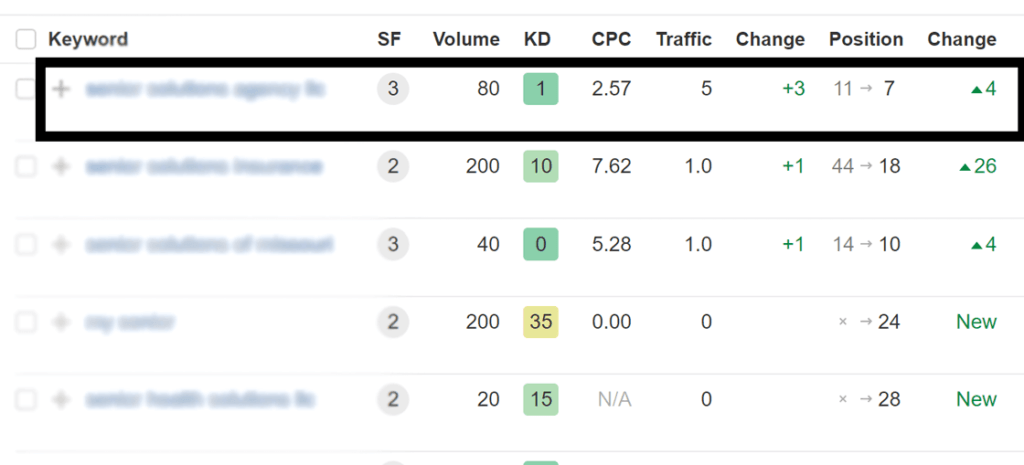
The important lesson wasn’t simply that the ranking improved.
The search volume for the keyword wasn’t enormous.
That was intentional.
Common Insurance Agency SEO Mistakes
Trying to Rank for Everything
You don’t need every insurance consumer on the Internet. Start with the products, problems, and markets where your agency has a legitimate competitive advantage.
Choosing Keywords Based Only on Search Volume
Volume without intent can create impressive reports and disappointing revenue.
Publishing Thin Location Pages
Changing the city name on the same generic page dozens of times doesn’t suddenly make the content useful to consumers in those markets. If you’re building local content, give the page a reason to exist.
Creating Content Without Internal Links
Every new article should have a place within your larger content strategy.
Writing for Search Engines Instead of Insurance Consumers
Keywords are useful. Awkward, repetitive writing isn’t. Your first job is to answer the reader’s question.
Ignoring Existing Content
Sometimes updating and reorganizing an established article is more valuable than publishing another one.
Reporting Traffic Without Reporting Leads
If SEO is part of your customer acquisition strategy, eventually connect it to customer acquisition.
Outsourcing Your Expertise
A writer can help you communicate your knowledge. An SEO platform can help identify opportunities. AI can help research, organize, edit, and accelerate the process.
None of those tools has sat across the kitchen table from your client.
Your experience is the part you shouldn’t outsource.
How Long Does SEO Take for an Insurance Agency?
There isn’t a responsible universal answer.
A page on an established insurance website targeting a very specific local search may move much faster than a new domain attempting to compete for a national life insurance keyword.
Timing depends on factors such as:
- The competitiveness of the search.
- The history and authority of the website.
- The quality of existing content.
- The agency’s market and geography.
- Technical problems with the website.
- Existing links and mentions.
- Internal linking.
- The quality and usefulness of competing pages.
- How consistently the agency executes.
SEO should generally be viewed as a compounding marketing asset rather than a switch you turn on for immediate leads.
How Much Should an Insurance Agency Spend on SEO?
Start with the economics of the business rather than an arbitrary marketing budget.
Ask:
- What is a new customer worth?
- What is the first-year revenue?
- What is the renewal value?
- How long does the average customer remain?
- What percentage of leads become appointments?
- What percentage of appointments become policies?
- Which products have cross-sell opportunities?
Should You Hire an Insurance SEO Agency or Do It Yourself?
You can absolutely handle parts of SEO internally.
In fact, insurance expertise should remain heavily involved regardless of who does the technical work.
The question is usually one of time, expertise, and execution.
An agent may understand the customer better than any outside marketing company but not have time to perform keyword research, update old content, fix technical issues, build internal links, monitor Search Console, optimize local profiles, and manage an editorial calendar.
That’s where outside help can make sense.
If you hire someone, make sure they understand the difference between generating website traffic and generating insurance business.
Insurance Agency SEO Checklist
- Define the insurance products you want to grow.
- Define the geographic markets you actually serve.
- Identify your most valuable customer types.
- Review Google Search Console for existing visibility.
- Identify your highest-performing organic pages.
- Identify pages that have lost traffic or rankings.
- Research high-intent and long-tail searches.
- Map keywords and topics to the appropriate pages.
- Create clear product and service hubs.
- Improve internal links between related pages.
- Update outdated insurance content.
- Improve titles, headings, introductions, and calls to action.
- Optimize and maintain your Google Business Profile.
- Keep core business information accurate across the web.
- Build a repeatable review process.
- Look for legitimate industry and local authority opportunities.
- Add appropriate structured data where useful.
- Track organic calls and form submissions.
- Connect leads to your CRM when possible.
- Measure qualified opportunities, policies, and revenue.
Insurance Agency SEO Services From Redbird
Some agencies want to learn SEO and execute it internally. Others need help building the strategy, identifying opportunities, or doing the work.
Redbird works specifically within the insurance industry, which allows us to approach SEO from both sides of the equation: search visibility and insurance economics.
Our insurance agency SEO work can include:
- Initial and ongoing SEO audits.
- Insurance keyword and search-intent research.
- Content strategy.
- Content briefs and outlines.
- Copywriting and content optimization.
- Internal linking architecture.
- Backlink and authority strategy.
- Editorial calendar development.
- Title and search-result optimization.
- Google Business Profile optimization.
- Local search strategy.
- Competitor and keyword monitoring.
- Inbound call and lead tracking.
- Conversion strategy.
- Ongoing content updates.
Frequently Asked Questions About Insurance Agency SEO
What is SEO for insurance agencies?
SEO for insurance agencies is the process of improving an agency’s website and digital presence so consumers and search engines can more easily understand the products, expertise, markets, and information the agency provides. The business objective is to turn relevant organic visibility into qualified traffic, leads, and ultimately insurance customers.
Does SEO work for insurance agents?
SEO can be an effective customer acquisition channel for insurance agents, particularly when the strategy focuses on specific products, customer problems, long-tail searches, and legitimate local markets. The economics depend on competition, execution, conversion rates, and customer value.
What are the best keywords for insurance agents?
There is no universal list of best insurance keywords. The most valuable keywords depend on the products you sell, your geography, your expertise, competition, and the intent behind the search. A low-volume search with strong buying intent may be more valuable than a broad keyword with thousands of monthly searches.
Is local SEO important for insurance agencies?
Yes, particularly for agencies that rely on local clients or want to be discovered by consumers searching for an insurance professional in their area. Local visibility includes your website, Google Business Profile, reviews, business information, local relevance, and broader prominence across the web.
Do insurance agencies need a Google Business Profile?
For eligible agencies serving local customers, a properly maintained Google Business Profile can be an important part of local visibility in Google Search and Maps.
How often should insurance agencies publish content?
There is no magic publishing frequency. Publishing one genuinely useful resource that supports an important part of your business can be more valuable than publishing several thin articles simply to maintain a schedule. Consistency matters, but usefulness and strategic relevance matter more.
Should insurance agencies use AI to write SEO content?
AI can be useful for research, organization, outlines, editing, analysis, and accelerating content production. Insurance expertise still matters. Strong content should incorporate accurate product knowledge, first-hand experience, original examples, and human review rather than simply publishing generic generated text.
Are backlinks still important for insurance SEO?
Links can help search engines and users discover resources and understand relationships across the web. Insurance agencies should focus on earning legitimate, relevant references rather than accumulating low-quality links solely for a metric.
What should an insurance agency measure from SEO?
Start with search visibility, queries, rankings, organic traffic, and landing-page performance. Then move farther down the funnel by tracking phone calls, form submissions, appointments, qualified opportunities, applications, policies, premium, and revenue wherever your attribution and CRM systems allow it.
Final Thoughts on SEO for Insurance Agencies
SEO has become more complicated since we first started building insurance websites, but the underlying strategy isn’t complicated.
Understand your customer.
Understand how they search.
Create something genuinely useful.
Organize your website so people and search engines can understand it.
Build a legitimate reputation around your agency.
Give visitors a logical next step.
Measure whether any of it turns into business.
Do those things consistently and you’re no longer just “doing SEO.”
You’re building an asset that can help your agency get discovered before the prospect ever knows your name.
Want to Know What’s Holding Back Your Insurance Website?
Redbird works specifically with insurance agents, agencies, and distribution organizations. We can review your website, organic search visibility, content, competitors, local market opportunities, and conversion strategy to help identify where the biggest opportunities exist.